Is product-led growth right for your product

Is product-led growth right for your product
Product-led growth is the right strategy for a product when the product can be evaluated, adopted, and expanded without a person in the loop, and when the offer is simple enough that a user can choose it without a negotiation. Where that is true, letting the product do the selling lowers the cost of every customer and reaches people a sales team could never afford to chase. Where it is not true, a product-led motion produces sign-ups that never activate, and that is more expensive than having no motion at all.
The decision is not a matter of taste or trend. It is a readiness test, and most of the test is about the product rather than the marketing. This is the second article in a four-part series on product-led growth. The first, "Part 1, what is product-led growth strategy", covers what the strategy is. This one is about whether it fits your product, and when.
The readiness test: four honest questions
Before committing to product-led growth, answer four questions about your product as it is today, not as you hope it will be.
Can a new user reach a first useful outcome without a human? If the product needs an implementation call, a configuration session, or training before it does anything worth paying for, the self-serve motion has nowhere to begin. Does the product reach value fast enough to hold a user’s attention? A product whose payoff arrives after three weeks of setup will lose most users before they ever see it, and no funnel rescues value that comes too late. Can a user choose and buy an offer on their own? If pricing requires a quote and packaging requires an explanation, the user cannot complete the motion without the salesperson product-led growth is meant to remove. And can a user expand their own usage without a call? Land-and-expand is where product-led growth makes its money, and if growing from one team to ten requires a renegotiation, the expansion engine is off.
Four yeses mean the product is genuinely ready, and the work ahead is to build the motion well. A no in any of them is not a reason to abandon the strategy. It is the specific thing to fix first, and it is almost always product work rather than marketing work.
The timing hidden inside the readiness question
Even when product-led growth clearly fits, there is a sequencing trap that catches teams who treat the decision as a single switch. The foundations of a product-led motion and the motion itself mature at different rates, and building them in the wrong order is the most common way a well-suited product still fails to grow.
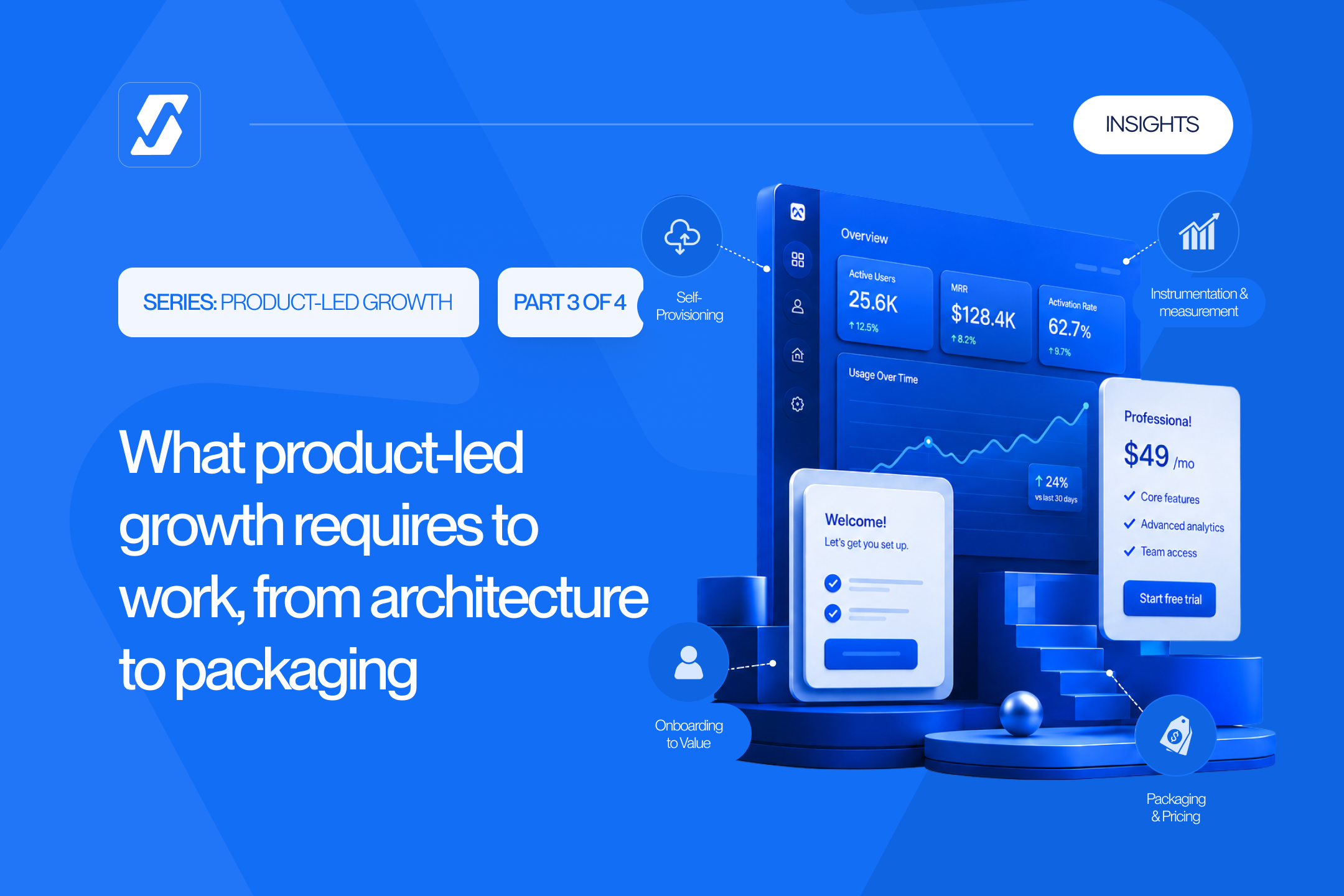
The foundations are structural and belong early, because they cannot be retrofitted without a rewrite. The product has to provision a new user in isolation, guide them to value with sensible defaults, and record what they did so activation can be measured. The motion is commercial and benefits from patience, because you cannot package capability you do not yet have, and you cannot know what to charge for until the product tells you what users value.
Metarelic Studio’s work on Metarelic People, the HR and payroll platform it designs and stewards, follows that order. Completing the platform’s first phase was not about switching on a funnel. It was about laying the rails: statutory rules encoded into the architecture rather than configured per customer, so a new organisation reaches a compliant payroll without a consultant; tenant provisioning that can stand up and reset an organisation programmatically; and a layered analytics stack so the product can see how it is used. None of that is a growth feature on the surface. It is the part of the growth motion that gets more expensive the longer it is left, which is exactly why it comes first.
So the readiness test has a time dimension. A product can be the right candidate for product-led growth and still not be ready to switch the motion on, because the foundations are not yet in place. Build those first. Start the motion when there is capability worth packaging.
The failure modes worth naming
Product-led growth is oversold, and the honest version of this article names where it breaks.
It breaks when it is forced onto a high-touch product. Some products are genuinely better sold by a person, because they are complex, expensive, or bought by a committee that wants someone accountable. Bolting a self-serve motion onto one of those does not make it product-led. It just adds a leaky funnel in front of a sales process that may already be working.
It breaks on the wrong free model. A freemium tier so generous that no one needs to upgrade produces a large user base and no revenue. A free trial on a product that takes weeks to show value expires before the user is convinced. The free-to-paid model has to match how quickly the product reaches value and how its value scales, and getting it wrong undermines the strategy quietly, while the sign-up numbers still look healthy.
And it breaks when the motion is switched on before the foundations exist. A growth motion laid over a product that cannot onboard, measure, or expand a user on its own does not produce growth. It finds the gaps faster, and in public.
Where hybrid is the real answer
For many products, the honest answer to “is product-led growth right for us?” is “for part of the business.” Product-led growth handles the self-serve and smaller customers, where a salesperson would cost more than the deal returns. A sales-led motion handles the larger, more complex customers, where a human relationship earns its cost. The two are not rivals. They are a spectrum, and the strategic question is which one leads and where the other takes over.
Treating the decision as all-or-nothing is its own mistake. A product can run a clean product-led motion for individuals and small teams while a sales team works the enterprise accounts that will never buy through a self-serve flow. Deciding that up front shapes how the product is built, because the self-serve half still has to meet the four-question test even if the enterprise half never does.
What this means in practice
Run the four questions against your own product honestly. Where you get a yes, product-led growth is a real option and the work is to build the motion well. Where you get a no, you have found the next thing to fix, and it is almost certainly in the product. Then check the timing: are the foundations in place, or are you about to switch on a motion the product cannot yet carry?
Metarelic Studio treats the foundations as a Product Build question and the motion as a Product Growth question, deliberately, because they are answered at different points in a product’s life. Conflating them is what leads a well-suited product to launch too early and stall.
Product-led growth is right for your product when the product can carry it, and ready for your product when the foundations are already poured. What those foundations actually have to contain is the subject of the next article: Part 3, What Product-led Growth Requires to Work.