What Product Led Growth Requires to Work
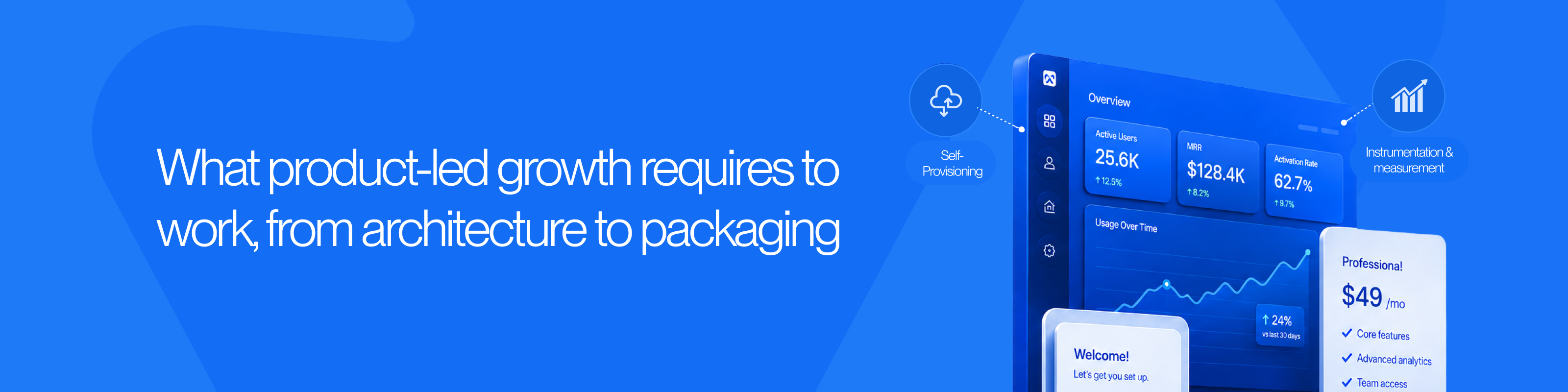
What product-led growth requires to work, from architecture to packaging
Product-led growth fails far more often in the product than in the marketing. The strategy asks the product to do the convincing, and a product that cannot provision a user, guide them to value, measure what happened, and present an offer they can buy alone has nothing for a growth motion to run on. The funnel is the visible part. The four things underneath it are what decide whether the funnel converts or leaks.
A product is ready for product-led growth when four capabilities are in place.
a. It can stand up a new user in isolation, on its own.
b. It can carry that user to a first useful outcome without a human.
c. It can measure what the user did, well enough to tell activation from drop-off.
d. And it can present a package a user can choose without a conversation.
Miss any one of these and the growth motion inherits the gap. This is the third article in a four-part series; the first two cover Part 1, what product-led growth strategy is and Part 2, whether product-led growth is right for your product. This one is about what it requires.
1. Self-provisioning, so a user can start without you
The first requirement is that the product can create a new, isolated workspace for a user with no manual step in between. In a multi-tenant product this is the tenancy model, and it is foundational because every other part of the growth motion assumes a user can simply begin. If standing up a new customer requires an engineer to run a script or a support agent to flip a setting, there is no self-serve motion. There is a queue.
This is harder than it looks, because isolation has to be real. One organisation's data must never be reachable from another's, and a new tenant has to arrive in a known-good state every time, not a slightly different one depending on who set it up. In Metarelic People, the HR and payroll platform Metarelic Studio designs and stewards, tenant provisioning runs through a Strategy and Pipeline pattern, so an organisation can be created and reset programmatically rather than by hand. That is not a growth feature on the surface. It is the precondition for any growth feature to exist at all.
2. Instrumentation, because you cannot grow what you cannot see
The second requirement is measurement. Product-led growth runs on knowing what users actually do, which users reach value, where they stall, and what separates the ones who stay from the ones who leave. Without that, every decision about onboarding, packaging, and pricing is a guess, and guesses are expensive when the product is the thing doing the selling.
Instrumentation is one of the things that is far cheaper to design in than to add later, because retrofitting it means threading measurement back through code that was never written to emit it. The product must record events as it runs, and it has to do so in a structure that can actually be queried. Metarelic People combines materialised views, PostHog, and the Sentry, Horizon, and Pulse tooling into a layered analytics stack, so usage, errors, and performance can be seen rather than inferred. The point of building that early is not dashboards. It is that, when the time comes to decide what to package or where onboarding is failing, the answer is in the data instead of in an opinion.
Full-funnel attribution is the same requirement pointed at spend. Mapping how a marketing pound becomes a paying customer, as the studio did for [link: Giftme Hub], only works when the product underneath can be measured end to end. The attribution is downstream of the instrumentation. You cannot attribute what you never recorded.
3. Onboarding to value without a human
The third requirement is that the product carries a new user to a first useful outcome on its own. This is where most product-led motions actually break. The user signs up, lands in an empty product, does not know what to do first, and leaves. The sign-up was free to generate and worth nothing, because activation never happened.
Onboarding without a human means smart defaults, sensible starting states, and in-product guidance that replaces what a salesperson or an implementation consultant would otherwise have done. The product must make the easy path the obvious one. A useful test of this is whether the hardest part of using the product can be reached without configuration. In a payroll product, the hardest part is being correct, and correctness usually means a consultant. Metarelic People encodes the statutory rules into the architecture rather than leaving each customer to configure them, so a new organisation reaches a compliant payroll by default rather than by expertise. That is what onboarding to value looks like in practice: the product, not the user, carries the difficulty.
This is also where the studio's framing of AI belongs. AI accelerates the work of building these onboarding paths, drafting flows, generating first-pass guidance, surfacing where users stall, but it does not decide which first outcome matters most, or which default is the right one. That judgment is the product decision, and it is the part that determines whether onboarding actually lands.
4. A package a user can choose alone
The fourth requirement is commercial. For the product to do the selling, there must be an offer a user can understand, evaluate, and choose without a negotiation. That means packaging simple enough to be self-evident and pricing a user can commit to without asking permission.
This is the requirement that benefits most from patience, and it depends on the other three. Good packaging comes from knowing which parts of the product people actually value, which is something only the instrumentation can tell you. Simpler packaging, with fewer permutations, converts better and is easier to maintain, but you can only simplify once you understand the product's real value to its users. Package before you have that understanding and you are guessing at the offer as well as the product.
What this means in practice
If you are assessing your own product for product-led growth, run it against the four.
(i) Can a user start in isolation without a manual step?
(ii) Can the product carry them to value without a person?
(iii) Can you see what they did clearly enough to act on it?
(iv) Can they choose an offer without a conversation?
The gaps in that list are the real roadmap for becoming product-led, and they are almost always product and engineering work, not marketing.
The studio treats the first three as Product Build decisions and the fourth as a Product Growth decision, because that is where the work actually sits. A growth motion laid over a product that meets all four amplifies a product that already works. Laid over a product that meets two of them, it simply finds the gaps faster, and in public.
Product-led growth is not something you add to a product. It is something a product is either built to support or not. The funnel everyone sees is only ever as good as the four things underneath it that they do not. Once those four are in place, the question becomes how to tell whether the motion is working, which is the subject of the final article: Part 4, how to know product-led growth is working.